As I mentioned last Friday, I headed down to the Atlanta, Georgia dance community over the long weekend for the first ever Catapult! weekend, which showcased up-and-coming callers and bands. One of the acts featured was DC's own dJ improper, who led a discussion about alternative contras for musicians and organizers. Some of the discussion involved some of the myths about alternative contras, and I figured I'd feature a few here since if one person's asking about these, it's entirely possible there are more than we've seen so far: Myth: All the dancing is by necessity like the videos of alt-music contras on YouTube. This one is possibly one of the bigger myths that keeps a lot of communities from giving this alternative contra thing a shot. Seriously, they're not all like that. There are some dancers who pull out moves that go really far afield of the contra dance many are used to. Many of the other alternative dance communities have less embellished dances. Of course the cameras will be looking for something neat to film; this doesn't mean people should be intimidated by the stuff they see on the Internet. In fact, some series specifically market themselves as "community-centered dance" and declare a no-lift, no-dip zone in order to be less intimidating to newcomers.
Myth: All alternative contras use strobe lights and fog machines. There has actually been a trend lately to ban these in consideration of people who might be negatively affected by strobes and fog machines. This is meant to be fun for everyone involved.
Myth: Only strict techno music works for this sort of event. All sorts of alternative music for contra dance has been tried and there's certainly room for more: in Maine they have had a Beatles contra and a hip-hop contra, for example, but there's no reason that the type of music can't be tailored for a community. I've heard a few people mention that the idea of a Motown contra appeals to them or one could use doo-wop or another genre entirely. It's easier for the caller and dancers to navigate if the music is mixed to retain contra phrasing, but there have been events that have worked with much looser phrasing as well.
Myth: I can save lots of cash and just grab a random sample of tunes from someone's iPod.
There's a range of options out there, from premixing songs for phrasing and length on an iPod to having a DJ mixing the tracks live to bands that incorporate varying levels of live music and are otherwise like a traditional contra band. From talking to people, it seems that events have tended to go more smoothly when this extra preparation has happened .
Myth: Using a DJ for so much as one event will kill live music in the contra community. I am not going to argue the aesthetics of traditional, acoustic, live music versus recorded-sample music. There is room for both kinds of events in the contra world. Most of the people who come to your alternative contra are likely the people in your contra community. There may be some others who come and stay, but the vast majority of the time people at alternative contras love live music too and will show up at the acoustic events too. Frequently, the organizers of alternative contras also organize (or play/call for!) traditional contras as well. It's a different sort of energy than the traditional contras, but most events still have the safe atmosphere of a contra community, which is an attractive quality. (And as somebody mentioned in the discussion, there are ways to make the desired atmosphere clear when you market the event.) Alternative contra enthusiasts still go to the traditional contras. The people I've talked to have no interest in having the Tradition go away, by any means; rather they want to explore it more fully through a change in context. I wish I hadn't been late to the chat -- the comments were really neat -- but I really liked that in addition to featuring some very cool bands and callers who haven't yet burst onto the national stage, there was room to talk about some of these other trends. Many thanks to Jeremiah Seligman (a.k.a. dJ improper), Penelope Weinberger (organizer of DC's Contra Sonic), and Julie Vallimont (who straddles the Tradition and techno sides of things amazingly well while organizing Spark in the Dark up in Boston) for participating in the discussion, and to the fabulous folks who came out and asked really good questions!
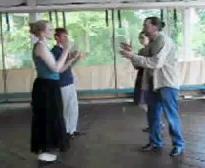
This week's flourish is a neat little back-lead that can be pulled out on a twirl-under. And one of the cool little things about it is that it can't be led -- only back-led. This comes from our friend Kevin Mabon and some of his friends at our home dance of Glen Echo. You, too, could have your flourishes featured! Drop us a line!You might notice that this week's flourish is up a little early -- Steve and I head for the Atlanta, GA area to dance to the Catapult! Showcase, which among other things will feature one of Julie Vallimont's other bands and a workshop for techno contra organizers, callers, and musicians led by none other than Jeremiah Seligman, a.k.a. dJ improper. There will be more syncretistic goodness next Wednesday -- watch this space! Carry on Dancing, CS
While I was chatting with one of my caller friends, he used the term “secular religiosity” to describe the contra dance community. I have no idea if he coined the term or not, but really, the more I think about it, the more apt it seems to be. A lot of contra-dance-inspired goodness has crossed my radar lately, so I pass it along here: Nils Fredland: Work/Life BALANCE? -- It’s easy to forget that the itinerant callers and musicians are folks traveling far from their families for weeks at a time. This offers an interesting perspective as someone who lives it. Inside Nancy’s Noodle: Why Can’t Churches Be More Like Contra-dances? -- this is from 2009, but it still seems relevant; a pastor more explicitly makes the correlation between her church life and her contra life. Whether or not you share her faith, this makes for interesting reading. How To Make Life a Celebration -- A fairly recent post by Sarah Goshman talking about a techno contra she attended and how it’s really a celebration, and how this is a good and positive thing. Contra Dance Pandora Music Station -- Dancer Josh Telecsan kindly made this and shared it with the “Stuff Contra Dancers Say...” Facebook community. Others who are not in that Facebook group might benefit, so I boost the signal here. Erica Nielsen’s Blog -- this is in support of a book published about the contra and square tradition last fall, but the author is apparently touring in support of her book and recording her experiences here. Take a look! The esoteric art of great sound -- interesting article focusing on making EDM sound good in a dance hall; at some point I’d love to chat with someone who’s done sound for an EDM event and an acoustic event to find out what makes them different, sound-tech-wise. Kickstarter: The 2013 Contradance Calendar by Doug Plummer -- fans of 2012’s edition may be interested in this. Catapult! Showcase -- Steve and I are headed here this upcoming weekend; smaller-time and regional bands and callers get a chance to show their talent to a national stage. It will be wonderful to see old friends and make new ones!
As we've gone through our Friday Flourishes, we've been trying to make a point of indicating potential trouble spots and safety precautions. It occurs to me that a concentrated version of these might be useful to dancers who are just starting to explore flourishes, or who have been embellishing their contra dancing for a while now as a refresher (I know I've committed my share of dance floor sins). There's room for everybody. 1. Don't be a jerk. If you're not going to read this entry any further, commit this phrase to memory and use it as your mantra. Cranking arms, twirling people who have said they'd really rather not, sending your neighbor on to their next neighbor really late, or pulling out flourishes in crowded rooms where it could endanger yourself, your partner, or someone in the next set is just plain not cool. This is part of how flourishers get a bad name; let's rise above the rep, shall we? 2. Be aware. This is partly a reiteration of #1, but there are some specific points I think we should all remember: - Be situationally aware. Some dancers really get annoyed when other dancers twirl their neighbor in a circle left and thus break the connection between the partner pairs; some dancers are probably going to twirl your partner, too, and so you can create a really neat symmetry in the minor set if you do it too. Some people love the drama of dips; other people find the idea unthinkable. Some people have a deep respect for the dance as written, and only as written; other people like to embellish. A lot of being a good flourisher is being able to adjust your dancing depending on who is coming at you. As you dance, you get to know the room. Use that information to enhance everyone's experience, not just yours, and respect it when someone's idea of fun may be different from yours. We wouldn't be dancing if we didn't love it.
- Be temporally aware. Know where you are in the music. If you get an 8-beat swing, don't try to squish in a 12-beat swing flourish. If you've got a crazily long swing, you have more time to experiment and still be on time for the next figure.
- Be spatially aware. This plays into dancing in crowded rooms as well as pulling off some of the more dramatic flourishes. Frequently when someone is twirling particularly fast or is getting inverted into a dramatic dip, they are putting all their trust into their guide (i.e., the lead) that they will have enough room to participate in the flourish safely. To those who are looking into dips: for most of them, bear in mind that you do not get to control the dipee's lower body beyond shifting its center of gravity; if they want to kick their legs up, they can't see the space behind the dipper, and neither can the dipper. Physics tells us that two things cannot occupy the same space at the same time. Experience tells us that bruises (or worse) can result in the attempt.
3. If you are not sure that you can execute a flourish SAFELY, don't. 'Nuff. Said. 4. Try your best to be on time for figures. It happens to all of us, flourisher and non-flourisher alike; somehow you miscount a beat and you realize that your minor set is two beats behind the room, or you have to make a really big step in to balance for a set of Petronella twirls because you and your partner drifted further afield than you thought. No one will ever think less of you for the occasional oops. If you are constantly too busy playing with that cute new dancer to get back in time for the all lines forward and back, or if you're constantly progressing your neighbor on to the next person three beats late for an eight-beat swing, people will (rightfully) get a little annoyed. If your partner didn't start twirling as quickly as you thought into a chain flourish, don't guide all six twirls that she usually does. For many contra dancers, the dance has become a lead/follow dance form; that said, you're both still dancing with the rest of the room. See #1. 5. Remember it's just a dance. Even for flourishers, it doesn't have to be all about the fanciest steps. You end up in a line packed with new dancers. For some reason you have completely flubbed a lead you thought you had down cold. It happens. You started dancing, presumably, because it was fun; and as long as you're not harming anyone else, the practical side of the anti-flourish argument loses water. (The theoretical side will likely always be there, and the best thing flourishers can do is acknowledge other dancers' feelings and respect their existence, even if we disagree.) Think I missed something? Sound off in the comments!
This week's flourish was submitted to us by Lindsey Dono and Mark Pigman out in Oregon. It's a neat swing flourish with a very neat twist; take a look!
 http://youtu.be/PdBxhgf2AEk As we've been going through our various flourishes and such (by the way, please submit favorites and requests to us), we've gotten a couple of flourishes related to that two-beat "pause" in a Petronella twirl. While some people can't stand the two claps that have tended to follow it, preferring to rejoin hands and look at the other three people in the circle or do something else entirely,* we've also seen some really cute ways of eating up that time ( playing pattycake with your partner -- or all three other people in the minor set -- comes to mind). Obviously there are some dances that are written to require dancers to go straight into the next figure ( "The Cure for the Claps" by Bob Isaacs comes to mind, and every time it's called the room tends to stumble over not clapping for at least the first few iterations), but in the dances that don't require you to skip it, what's your favorite thing to do during those two beats? * I actually happen to like it when most of the room does those claps (or some sort of emphasis on those beats), for the record. It's an audible check as to whether you're on time in the dance and it tends to connect the room since it's too short to do too much else before you have to move on. But I also didn't start dancing until after the claps were pretty firmly entrenched, so this probably colors my opinion.
This week's flourish is a little something you can do when going from a gypsy into a swing, and a way to add a little momentum to your partner before you sweep them into a swing. Take a look: You, too, can have your flourishes featured! Drop me a line!Happy Friday to all! CS
I've noticed something interesting in the process of compiling Contra Syncretist that has left me a bit puzzled. It seems that gender-free contra dances, which have existed for something like 30-40 years, are being broadly lumped in with techno contras. While both techno contras and gender-free dances challenge specific assumptions of "traditional contra dance" (and thus do probably count as syncretism in a broad sense), the two underlying assumptions are qualitatively different. Gender-free contras challenge the heteronormative idea of men only dancing with women and women only dancing with men, and of the roles' definition coming from the gender of the person dancing it. Techno contras, on the other hand, tend to define themselves by changing the music, usually through adding some sort of electronic element (usually involving prerecording at least some of the music). The main reason that so far I haven't included more coverage of the gender-free contra scene is that I haven't been to a whole lot of those events. (They don't tend to happen as dedicated events in DC that I'm aware of, although role-swapping does happen in the breach, by necessity or volition.) That said, I don't understand why the two sorts of events get lumped together, New York City's gender-free techno contra dances notwithstanding. It seems to me that "they change some aspect of the traditional assumption" is a really, really broad brush and shortchanges the importance of examining each of those assumptions individually and why they're part of the living Tradition. If someone else can see a more coherent reason, I'm certainly open to discussion and welcome your thoughts.
Normally on this blog I try to keep myself pretty narrowly focused on stuff with at least a tenuous connection to the contra dance world (e.g., other projects of people who play at contra dances). However, when this particular cool thing crossed my RSS feed, I decided to make an exception. People who like Andy Reiner's other project Fiddlefoxx might be interested in The Speech Project by English musician and producer Gerry Diver. He has taken prerecorded footage of live interviews with significant figures in Irish music (folks ranging from accordionist Joe Cooley to Shane McGowan, for those familiar with that scene). The correlation between the speech patterns and the subsequent instrumentation is probably the most apparent in "Old Time Musicians." Unfortunately for those of us in the U.S., Diver is only taking this show on the road overseas in various Irish venues (with live instrumentation and a pre-looped video of the relevant pieces of the interviews), but listening to his concept and his work on The Speech Project's site reminded me quite a bit of hearing Phase X or Double Apex at work, but with really different recorded sounds as inspiration. A couple of these tracks even approach being square, although that wasn't necessarily the intent going in. I have seen this project called "the closest thing to folk dub[step]" in other reviews, but frankly I'd pit that assertion against the various techno-influenced contra bands over here (although the folk and contra music scenes appear quite removed from one another -- but that's another kettle of fish). Regardless, this is still really neat and the tracks do rather tend to stick with the listener in a lyrical loop.
Also, it appears that there's a bit of debate over medleys from earlier -- go weigh in! Happy Friday! CS
|