The end of 2012 is nigh! If your resolution for next year is to call for a techno contra event, here are some things you should know, as compiled by me from the various interviews with callers to date over the last 20 months or so:

1. If possible, consult with the DJ beforehand -- preferably to be able to match rough tracks to dances, but at the very least to get an idea of the presence (or absence) of traditional phrasing, tempo, etc.

2. Be aware that traditional phrasing may or may not be present; this puts more onus onto the caller to guide the dancers if needed. The caller has to be sure to pay close attention to the music, especially if it's not familiar.

3. Pick simpler dances: they tend to work better than ones with really complex moves in techno contra.

4. Find out if there will be black lights, strobe lights, or other lighting effects. These may affect how well you can "track" dancers from your vantage point. You will probably need to keep more of an eye on the dancers than you might at a traditional contra to keep the room together.

5. As a corollary to #4, be especially aware of crowding and other issues that may come up and pick dances accordingly; doing a dance with down-the-halls in a really crowded room gets really problematic at the bottom of the hall and you might not be able to see it as well as you would in a well-lit venue for traditional contra.

See something I missed? Sound off!

(This list will eventually be made into a PDF and made available for download on the Resources page. However, I wanted to open it up to comment first.)
 
 
Eric Harris is a Florida caller who came up to Glen Echo to call our Contra Sonic series after meeting the organizer and DJ in Atlanta. I caught up with him and asked him to share his thoughts on alternative contras and things he has learned along the way.

"I got the gig for Contra Sonic when I attended the Catapult weekend earlier this year.  While I had entered, I didn't make the cut this year, but a band (On the Fly) that I suggested enter, did make it.  They were appreciative and paid the entrance fee for the weekend," says Eric. "While I was there I was determined to 'network' and come away with not only contacts, but at least  one gig.  I attended the techno/alt workshop where I met Penelope [Weinberger] and  Jeremiah [Seligman, a.k.a. dJ improper] and I asked to come up to Glen Echo to call."


Among other comments, caller Ted Hodapp mentioned that something he might add to future techno calling gigs would be to "...try and figure out a few dances that might specifically link up to medleys devised by our DJ."

This reminded me of Louis Dow in Miami, FL discussing writing dances to go with specific songs he spins. Another caller I talked to touched on an interesting concept that more modern lyrical content has been introducing to contra dance -- the infusion of content, especially having to do with lyrics and the dimension they can add a new layer of mood to the experience.

In a traditional contra, a caller will generally approach the band and say something like, "I want the first dance to be smooth and sultry,  the second one to have a lot of Petronella turns and balances, and the third one has a lot of energy," and the band agrees on tunes to play accordingly. In a contra that incorporates music with lyrics, it can go the other way -- a DJ can say, "these are the tunes and mixes I have" and the caller can plan a program to suit (or, a DJ/caller might align tunes and dances due to a confluence of names, or even write dances to the tunes).

It's a reversal of the normal work order for a contra dance, and it seems like it might open up some intriguing possibilities. I wonder if others have experimented with this as well...and whether or not dancers (besides me) notice such things. I welcome your thoughts! 
 
 
One of the recent Contra Sonic series installations was called by local (to Glen Echo) caller Ted Hodapp. As it was his Contra Sonic debut, I asked him about the experience.

"I was asked by Penelope [Weinberger]. [I'm] always up for a new challenge in calling contras," he says. 

"[dJ improper and I] had a few brief discussions in advance, but mostly addressed how things would flow just prior to the dance. This was mostly concerned with timing, how to 'read' his display to help in the event that dancers moved off the phrasing, and how transitions would work."

Given the preparation involved, I found it particularly interesting to hear what Ted thought were the surprises in the experience: "I think the biggest surprise is how well certain types of music work for this genre, and how well certain types fail. Rhythm is clearly the dominant structure for most pieces of music, but the melodic themes also make a huge difference in the energy of the dancers.... The biggest difference [between traditional and alternative contra] is that there is very much less phrasing information available to the dancers [in alternative contras]. Consequently, using dances with more basic moves helps a great deal. Besides, doing intricate dances can get in the way of enjoying the music.... [It's] all a part of the larger continuum of enjoying social dance. It's not for everyone, but it is a fun way to enjoy contra." 

Would he do it over again? "Absolutely. I would try and figure out a few dances that might specifically link up to medleys devised by our DJ."

Ted will get a chance to implement that when he and dJ improper put on a techno contra at the Tapestry Folkdance center in Minneapolis, MN on August 23, 2012. Many thanks to him for talking with Contra Syncretist!
 
 
Picture
I was at a contra dance recently that was much more crowded than usual. This is awesome for the supporting organization and I think it’s good when more dancers are exposed to different experiences on general principle; however, since it was significantly more crowded, the crowding did alter the experience a bit.

I was talking to another dancer about this and zie suggested that perhaps there were some calls that worked better in less-crowded halls (we know this to be true for flourishes). I was thinking about this and decided to open it up to the crowd. Are there calls (we’re talking “standard” calls here, that would come from the caller, not stuff that the dancers make up on their own or dips/lifts/etc. -- flourishes fall under the “don’t be a jerk” mantra) that generally work better when the room isn’t as crowded?

I know that in both techno and traditional contra events, there have been times where I thought calling a dance with a promenade across the set, for instance, might not have been the best idea (generally as I ran into other dancers, either through their fault or mine). Do unbalanced dances, where only half the couples -- i.e., the actives -- swing their partner, work better or worse in crowded halls, or does it entirely depend on whether the the inactives will “cheat?”

Is it possible for a caller to tailor the selection of dances based on how crowded the venue is? How?

I’m honestly not sure what I think about this yet -- I welcome discussion in the comments! 


Picture
From VickiHerndon.com
Chattaboogie 4, held this past January in Chattanooga, TN, was memorable for a few reasons: one, the weekend aimed to bring together two bands with a heavily electronic influence -- Perpetual e-Motion and Double Apex; two, it had the same band and callers two years in a row (Chattaboogie 2011 had featured Perpetual e-Motion, Seth Tepfer and Vicki Herndon), and three, it particularly highlighted differences between the two bands (who use some or all live music in their electronic mixes) and a DJ when Julie Vallimont of Double Apex switched formats and DJ'd a designated techno contra late on Saturday night. I talked to organizer and caller Vicki Herndon about this to get a behind-the-scenes look.


Picture
Photo from www.davecolestock.com
A couple of weeks ago, the crossover contra concept spread to Harrisburg, PA by way of an evening event called by Dave Colestock with music by dJ improper. I caught up with Dave online and asked him about the experience.

Dave says, "I was familiar with the concept [of techno contra], having called a techno slot during a gender free dance I called in New York City in 2010. In October of 2010, during a Halloween dance I called at Locust Lane, I incorporated an extended mix of 'Flashlight' by Parliament. The group really enjoyed it. Two months later when I called the Friday Night Dance at Glen Echo on January 14, 2011, with the Open Band, I was asked by Penelope [Weinberger, Contra Sonic organizer] to add a techno dance to the program, sorta at the last minute, as the Contra Sonic event was upcoming in the following week. So, I called a single techno dance mix that night that was made by dJ improper, as the first dance of the second half of the that night's program."


Picture
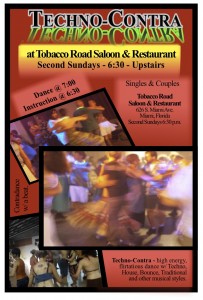
_Some of the more informative interviews I've conducted about the "new" evolutions of contra dance have actually shown me that the ideas of using recorded music and the like are actually not that new at all. I ran across Miami, FL techno contra dance series organizer Louis Dow, who started a monthly techno contra series at the historic Tobacco Road Saloon in Miami last month, and I asked him about his contra experiences -- both before and after he started the series.

"Someone sent me a link to a techno contra video," explains Louis. "I was impressed -– impressed because the kids were actually contra dancing but dancing the way the dance worked when I first started dancing. We had really hot dances, lots of improvising, heavy flirting, really pushing the energy level up. The dances I go to now have lost some of that, I think in part just because the dancers tend to be older. I want to get back to what I think of as 'real' contra dance. I actually started calling it 'roots contra dancing' but ended up going with 'techno' just because that’s the more common parlance."


Last week, I posted part 1 of a conversation I had with caller Will Mentor about calling techno contras. The conversation evolved into a discussion of Contrashock in New York City and Contrastock at Glen Echo last May, two events in which Will's role was pivotal and featured Perpetual e-Motion, Giant Robot Dance, Swallowtail, and was co-called by Nils Fredland.  Will is planning to repeat that role when Contrashock II and Contrastock II occur in September, with Elixir, Perpetual e-Motion, and Wild Asparagus.
 
 
Picture
_On October 29, the Spokane (WA) Folklore Society sponsored Techno Contra Deca-dance at the East Spokane Grange. It was a masquerade-themed crossover techno contra event featuring local DJ Gaga (Dennis Gagaoin, former host of Spintronica on radio station KYRS and owner of United Groove Merchants) and caller Ray Polhemus. The Grange was transformed for this Halloween event with fog machines and lighting effects and the event was heavily marketed as “a great chance to bring contra curious friend and show them that contra ain’t square!” per their press release. I caught up with Ray Polhemus after he called for the event to talk with him about Deca-dance and the techno contra trend.