We ended up talking the other week in a comment thread about what makes a good lead -- [Update, 3/13/13: and this works tangentially into the conversation about whether those designations should happen at all] but the other side of that seems to rarely be discussed. What makes for a good contra follow? (Or, to phrase it differently, what can a dancer do while dancing in the role that ends up on the right in a swing -- however you choose to designate it -- that will improve the experience for all?) 

To my mind it depends a bit on one's partner and the ability to respond to their leads, but in some ways that's kind of the point. I remember something North Carolina dancer (and electrotrad maven) Eileen Thorsos said on the matter when I interviewed her in 2011 that I remember really liking:  "....There's a lot of following -- understanding what's going on with your partner -- that's built into leading."

Do you agree? Is there something else that makes for a good follower/lady/right-hand-role in contra?  For those who answer, I'm also curious -- which role do you usually dance, and do you dance switch (i.e., dancing where you and your partner agree to trade roles through the iterations of the dance)?
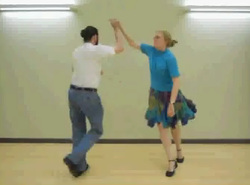

 
 
When Steve and I headed to dance to Perpetual e-Motion on Sunday night at Glen Echo, we decided we might do the initial forays into an experiment. Several weeks ago, one of my more vigorous partners (read: that guy who twirls the snot out of me every single time) made a comment about how he was tired, but "you're the one doing most of the work anyway."

Which got me (as someone who typically dances the follow's part) thinking: does the follow actually exert themselves more in a typical dance? There are people who object to my use of "lead" and "follow" on this blog because they believe it to be an entirely equal dance form for which those labels are (or should be) meaningless. Meanwhile, in a ladies' chain (which is so much more common than a men's chain that even a decent chunk of experienced dancers don't know how to pull a men's chain off smoothly, at least around these parts), someone dancing the lady's role and dancing without flourishes crosses the set and takes at least four medium-to-large steps around the outside of a circle, whereas someone dancing the gent's role will take maybe four small steps backwards to help the lady around the courtesy turn.


Picture
From http://youtu.be/fObawDvUAPg
As someone who usually dances the follow's role, I've noticed something interesting and I'm not sure if my experience is unique or not: at most traditional contra evenings I go to, I might end up dancing lead (not switch, where we trade, but straight-up lead) once or twice in the evening, tops. When I've gone to techno contras, on the other hand, I've ended up dancing lead a bit more often. I'm not sure if this is a matter of there are fewer people at the average techno contra than the average traditional contra I've been to (and so it's more likely that there's a gender imbalance and more available people who dance the "lady" than the "gent" roles) or if something else is at work.

On the other hand, my partner, who usually dances lead, reports that he usually has zero problem finding partners and that they're usually lining up to dance with him and that the only time he ends up dancing follow is when he dances switch. 

It is also worth noting that usually these dances where I've seen this are not billed as gender-free, so it may just be that I'm in a minority of women who are willing to lead (and hopefully do so reasonably competently). I've had several really fun dances as both a lead and as a follow (and plenty of fun ones dancing switch), so it's certainly not a complaint, merely a trend I've noticed. Maybe it's just that more people who dance the "lady" role end up at techno contras where we've headed (mostly the mid-Atlantic)?

Anyone else find this or see something I'm missing? Or, for that matter, find the opposite to be true?