When I spoke with Dennis Gagaoin (a.k.a. DJ Gaga) of Spokane, WA in late 2011, he mentioned the idea that techno contra might be a decent vector for outreach from the contra community:
"I believe it can even help people who aren't comfortable dancing since it provides a structure. All you have to do is know how to follow instructions!"
Dennis himself came to the contra scene through the "Deca-dance" gig he called in 2011 which was organized by Terra Price and called by Ray Polhemus.

Terra and her fellow organizers did such an effective job of marketing the event to newcomers that, as Terra mentioned,
"I actually had to do lessons on three separate times [in addition to the planned lesson before the dance] because we had so many new dancers."
How might others replicate this success?  Marketing is mostly making sure that you've answered five questions:
  1. Who is it, exactly, that are you trying to reach? The more specific you can be, the better. "The general public" is really hard to reach and a large percentage of them will ignore you anyway. "People in X age range who hang out in clubs but don't like it/people in X age range who like to dance/people in X age range who like music but not the club scene" are more manageable.
  2. What does your target audience need to know? This can be your event information.
  3. When might they be receptive to your message? When they're checking Facebook for the billionth time, when they're waiting for a bus, when they're in line at the grocery store, when they're at the campus bar with their friends....
  4. Where do they get their info? Where do they hang out?  This is actually the second-hardest part, I find. People get information many ways, from word-of-mouth to posters to listservs.
  5. Why should they care? What can you do for them? The more concrete you can be, the better. Unfortunately, "because it's awesome" doesn't really cut it with people who aren't already in the contra scene. (And besides, you probably had them at "there's going to be a contra dance.")
  6. How can you put your message into that venue? This can be the hardest part. If you want to attract, for instance, people 18-26 who who are uncomfortable in your average 21st century dance club setting, the ideal might be to go to the club and advertise there...but that might be impolitic. ("Hey you, you're miserable here, come to this other thing instead!" tends to be, at best, tacky. However, if you have your event at the same venue, or are using the same DJ, these could very much be avenues to the targeted audience. "If you like my DJing, come to something different next week!" works just fine.) However, the folks that are turned off by the club scene might be on your local college campus, or at the local coffee shop, or at the library, or....
 
 
Is one of your New Year's resolutions to put together an alt contra? Here are some things to consider, gathered from my various interviews with organizers, callers, and techno contra music providers over the last several months...
  1.  Are you looking to make the alt contra an outreach event, or a treat for the folks who have been contra dancing for a while? (Events seem to go better if they're aimed at one or the other...from my experience dancing at several of these, trying to do both tends to alienate the beginners or bore the advanced folks.)
  2. Where do the folks identified in #1 get their information? Facebook, campus posters, folk society newsletter, this blog, a particular coffee shop? Be sure to concentrate your marketing and outreach efforts there.
  3. Where are you going to get funding? Consult your local folk society for sponsorship.
  4. Consider your venue. How many people can fit into the venue, and how many do you expect? Consider pre-selling tickets if selling out is a possibility.
  5. Are you planning to have a "livetronica" type band, or a DJ? Make sure they know your expectations for the evening (especially if they're new to the contra scene) and that they talk to the caller as far ahead of time as possible to allow for coordination. Consider "taxi music" between dances.
  6. Has your caller called a techno contra before? (If not, you may wish to refer them to my previous entry offering hints.) Either way, put them in touch with the music as soon as possible so they can practice.
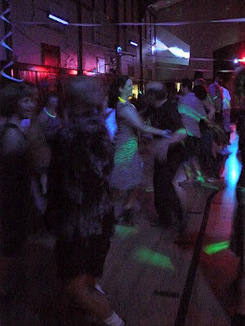
  7. Ambiance is key. Michael's craft stores have glow sticks at $1 for 15 and they're an economical way to add a clublike feel. Consider what you're doing about the lighting otherwise -- many dancers are not fans of fog and strobe lights, but colored lightbulbs, strings of lights and blacklight create really awesome effects (especially if the dancers wear reactive clothing).
See something I missed? Let me know in the comments.... I'm hoping to eventually make this list and the caller hint list permanent PDFs on the Resources page.
 
 
I first met Penelope Weinberger, Dance Chair of the Folklore Society of Greater Washington (FSGW), when one of my friends joined the Board. I have had the pleasure of knowing her not only in that capacity, but also as a friend who does awesome things like being the DC side of the organization of Contrastock I and II and the creator of the Contra Sonic alt music contra series, the first monthly series of its kind, in November 2010.

“I  wanted to have the first series,” she says. “I knew that other people were doing  special events and one-offs and I wanted an ongoing series.  I also wanted our alt music series to not be an exclusive thing. The first alternative contras were by invitation only and those were...the music and the calling were both recorded ahead of time, and for me that wasn’t what contra dancing is about.”


Picture
Click photo to see more from Eleanor Alice Benecki
At the end of June, (Contra Syncretist reader!) Megan Emerson and her committee arranged to have Firecloud come and play a techno contra in Portland, OR. I caught up with her afterward and asked her about organizing, community reaction, and following up on Chelsea Co's dances in Seattle, WA and Portland, OR. 

"I went to Chelsea Co's Binary Blackout in 2010. It being my first alt contra, I was delighted to find the dorky folk dancing I knew and loved -- but strewn with glitter and infused with bass and rife with scandalous blues dips. I had been recently head-hunted by the Portland contra committee as a representative of younger dancers, and I decided we needed to get in on this Hot New Thing. Having no idea what I was doing, I asked Chelsea for tips on what worked and didn't, brought in the same caller and DJ, and invited all the Seattle dancers I could find to come down and show us how it was done."

How did the community react? Was there any pushback?


Picture
From VickiHerndon.com
Chattaboogie 4, held this past January in Chattanooga, TN, was memorable for a few reasons: one, the weekend aimed to bring together two bands with a heavily electronic influence -- Perpetual e-Motion and Double Apex; two, it had the same band and callers two years in a row (Chattaboogie 2011 had featured Perpetual e-Motion, Seth Tepfer and Vicki Herndon), and three, it particularly highlighted differences between the two bands (who use some or all live music in their electronic mixes) and a DJ when Julie Vallimont of Double Apex switched formats and DJ'd a designated techno contra late on Saturday night. I talked to organizer and caller Vicki Herndon about this to get a behind-the-scenes look.


Picture
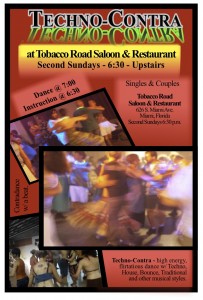
_Some of the more informative interviews I've conducted about the "new" evolutions of contra dance have actually shown me that the ideas of using recorded music and the like are actually not that new at all. I ran across Miami, FL techno contra dance series organizer Louis Dow, who started a monthly techno contra series at the historic Tobacco Road Saloon in Miami last month, and I asked him about his contra experiences -- both before and after he started the series.

"Someone sent me a link to a techno contra video," explains Louis. "I was impressed -– impressed because the kids were actually contra dancing but dancing the way the dance worked when I first started dancing. We had really hot dances, lots of improvising, heavy flirting, really pushing the energy level up. The dances I go to now have lost some of that, I think in part just because the dancers tend to be older. I want to get back to what I think of as 'real' contra dance. I actually started calling it 'roots contra dancing' but ended up going with 'techno' just because that’s the more common parlance."


_In March 2011, Mel Novner arranged for Double Apex to come down to Glenside, PA to play a techno contra party (dubbed High CONTRAst), called by Spider Vetter and Donna Hunt, for his birthday. After attending this wildly successful event, Vince Budnick was inspired to make the idea of a public Philadelphia-area techno contra (PATC) series a reality. His running start on this project was Technoberfest, held in Willow Grove, PA on October 22, 2011.
 
 
Hi all,   Just wanted to take a moment to say hi to the new readers on this blog, and make a few announcements/requests:

(Don't worry, the Friday Flourish has updated as usual, scroll down.)  

1. I've been combing the Internet looking for people who have called/organized/spun/etc. various techno and crossover contra events. If you know anyone who falls into this category, especially those I haven't talked to yet (see the list on the right of the blog page as a guide to people I've discussed on this blog in some capacity), please send them my way.  

2. I am also actively looking for bands who are doing something nontraditional with contra music. Send them my way too, or post about them in the Forum -- albums or bands, either one works for me; I'll happily review the albums or go talk to the band members if I can get my hands on contact info. 

3. I've been hearing inklings about several private parties back in the late '90's that some people are saying actually might have been the very first spontaneous crossover contras, predating the Whipperstompers and YDW events in 2008. I would love to hear from folks that were at or organized some of these for a possible future blog post.

4. As we've been saying every week on the Contra Syncretist YouTube Channel, we're constantly on the lookout for new flourishes. Upload them or send them our way, and they may end up featured as a Friday Flourish!

5. I've got more features and pages in the pipeline for this site that I'm hoping to roll out later this summer, and I do take suggestions for same from the peanut gallery. If you have ideas, please drop me a line!
 
 
On June 4, Club Contras caller and organizer Brian Hamshar and Sheldon “DJ Shel D” Lieberman debuted Technophoria, a techno contra event that they now plan to expand into a series; while the first one was in Asheville, NC, they’re looking at possibly making it a floating series in different venues. Unlike some others, this series uses a seasoned professional DJ to mix the tunes. I caught up with DJ Shel D to see what he had to say about the experience and what drove the idea of Technophoria.

“The idea behind Technophoria as an event came about because of my experience at a contra dance where they ‘experimented’ with contra dancing to alternative styles of music. With my previous experience as a studio DJ (mixing music at a local radio station in Brattleboro, Vermont) I knew that I could professionally mix and produce a show, and take ‘Techno Contra’ into the mainstream of contra dancing. The prospect of contributing to the evolution of contra and be the person to set the new standard in Techno Contra got me very excited!”
 
 
Jordy Williams’s name is one that has become synonymous with techno contras down in the Asheville contra community in North Carolina, as well as up and down the East Coast. His particular brand of techno contras are noted for including some of the sex appeal of the nightclub culture, rather than merely evoking that scene with the music and lighting as in a few other communities where these have taken root.

“I started organizing the first one in the spring of 2009,” he says. The first techno contra event he organized was on June 10, 2009 at the Asheville Contemporary Dance Studio. “It's a little hole in the wall in Downtown Asheville. We had about 70-80 people and it was completely stuffed.  It was cool though cuz [sic] it was in a basement so it had low ceilings (which gave it a cool underground feeling) and mirrors lining one wall.”

“The first one was inspired by a small handful of poorly executed techno contras that left me wanting it done right.”